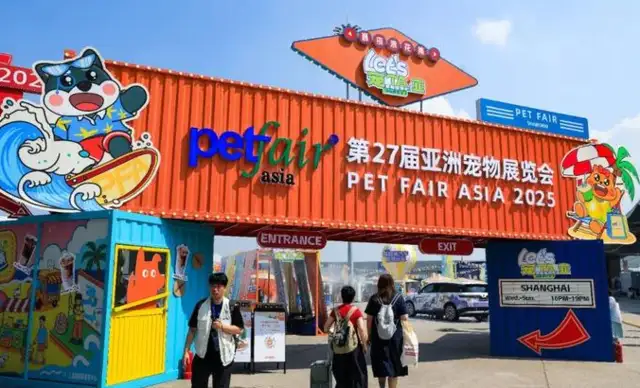
In the past week, the twenty-seventh Asian pet fair was held in Shanghai. On the evening of the inauguration, Wang Wei issued a circle of friends, "Showing the Battle": "The annual pet's "spring" — the Asian pet show is over. And five packs of dog food. I can't move the delivery." In the distribution, nearly 100 packages of staple pet foods and various types of snacks are distributed in a wide variety.
Wang Wei is a microcosm of a large group of lovers. Over the past week, young people at the Yapo Show have been showing off on social media: some have mocked themselves about "a generation of eggs for a generation" and others have played "a battle for a pet shop."
For a long time, the APA has been seen as the windbender of the pet industry, and according to statistics, the current APA record has been updated, attracting more than 130,000 professional viewers, over 390,000 pet lovers and more than 2,600 exhibitors and 310,000 square metres. There is a greater audience, a better variety and a better product.
In the evenings, pets, and other A-stocked pets also publish semi-annual 2025 reports in due course. The financial statements and the fairs bear witness to new industry trends.
Over the past two years, the domestic pet industry has shown vast market space and strong growth potential as the market demand for pets and services has been released with the continued increase in disposable income, the expansion of pet populations and the escalation of consumption.
The White Paper on the Chinese pet industry for 2025 shows that in 2024, the number of urban pets (dogs and cats) had reached 7689 thousand, an increase of 2.4 per cent over 2023; in 2024, the number of pet dogs was 52.58 million, an increase of 1.6 per cent over 2023; and in 2023, the number of pet cats was 71.53 million, an increase of 2.5 per cent over 2023.
A total of more than 120 million “pull children” brought the total size of China's urban pet (cat) consumer market to $30.2 billion, an increase of 7.5 per cent over 2023. In terms of sub-products, although pet products have become more abundant, pet food remains the dominant consumer market for pets, with a market share of 52.8 per cent.
This was reflected in the increase in the performance of companies listed in many pet industries during the first half of 2025: Of these, the first half of the year saw a profit of RMB 3,221 million, an increase of 32.72 per cent over the same period, and a net profit of RMB 378 million, an increase of 22.55 per cent over the same period. Thanks to pet rations and offshore warehousing operations, Zen Yuan pets received $1.435 billion, an increase of 14.59 per cent over the same period, and a net profit of $37.459 million from maternity, an increase of 20.14 per cent over the same period. With regard to Petit's shares, it was disclosed that in the first half of 2025, companies focused on the domestic market with their own pet food brand “divine” businesses, which grew by almost 50 per cent.
At the same time as the industry is growing rapidly, new trends are emerging. According to Petit shares, there are four major current trends in the pet industry: the rise of national goods, the increase in penetration and consumption, increased market concentration, and supply chains and product power as key to winning.
Similar observations were made with regard to pets, which in their financial statements pointed out that, as per capita income increased, the demand for pets by their owners expanded to individualize their supplies and placed higher demands on product quality, not only accelerating industrial upgrading and product overlay, but also driving the rapid growth of the industry. At present, pet consumption has gradually been included in the regular spending of pet-breeding households, with a steady increase in the willingness to consume pets and a gradual decrease in sensitivity to the price of pet products.