Driven by the wave of artificial intelligence, the scenes that existed only in science fiction films are moving into reality: the Ai translator can make golden hair dogs understand the command to “take a remote controlr”, and the “Auto-Cat Stick” uses algorithms to simulate the trajectory of prey to mitigate the “relationship” of pets. “Deep penetration of technological elements has created new growth points and development opportunities for the pet industry, driving firms to innovate continuously, thereby driving the entire industry to leap to higher dimensions and building an intelligent environment for sustainable development.” Analysis of Wang Qi, Permanent Vice-President and Secretary-General of the Guangdong Association of the Petty Industries.
Emotional consumption driven market break-ups: from “care” to “know-how” demand escalation
Journalists interviewed several young pet owners in recent days and found that there was a general desire to better understand their thoughts and emotions. After 95, the cat boy Xiao Mei said, "Sometimes I look at the cat and scream at me, and I don't know what it really wants, and if it does have a reliable translator, it makes me understand what it means, and in less expensive circumstances, I think it's worth it." Yao, a dog-breeding young man in '92, also said, "I'd particularly like to communicate more smoothly with my dog and feel like we have a pet translator that can bring us closer together and pay for it." Such claims reflect the desire of young pet owners for deep company and communication.
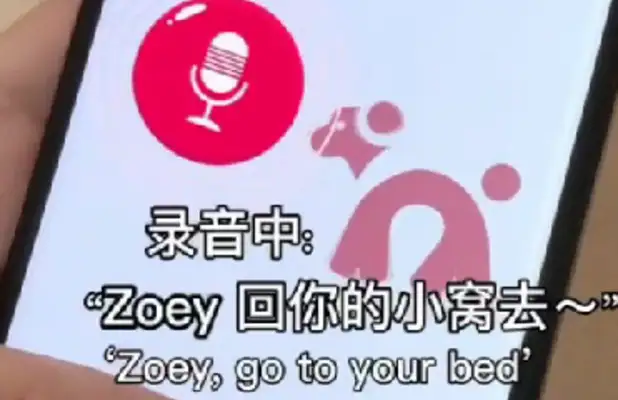
When the traditional rearing model no longer meets the high demand of young people for emotional interaction, intellectual hardware begins to recreate the pet landscape with the power of technology. In the case of the pet translator Traini, a recent video on the social platform of the “Doggy Dialogue” triggered a heat: the pet owner gave the “Go back to your nest” directive through Traini, and the dog did it precisely.
User gives instructions using Traini
Wang Qi notes that the pet economy is currently undergoing an overall escalation driven by “emotional values”, with consumer demand extending from basic food supplies to diverse areas such as health care, emotional services, cultural entertainment, etc.
According to Wang Tung Yun, General Manager of the Guangdong Hongwei International Exhibition Group Ltd., urban pets are no longer merely mere entertainment offerings in the narrow sense of the term, but are companions and even part of family members. This “emotional consumption” is continuously driving the economic upgrading of pets and plays a key role at this stage.
This determination is fully supported by market data. Treasure-seeking, The Great Three Caring Trends Keywords of 2025, shows that the turnover of pet language translators has increased by almost 74 per cent over the same period, a boom that directly reflects the strong demand for smart pet equipment by young consumers. The 2025 Report on Consumer Trends in the Petty Industry, published by the Kyoto Institute for Consumer and Industrial Development, also indicates that 61.5 per cent of users are willing to pay for the “emotional health” of pets and that smart devices are just demand. These data suggest that young people are more inclined to enhance their emotional interaction with pets through technological products.
An analysis of the 2024 Chinese pet industry study by Iri recommended that changes in the family structure of the population give rise to emotional attachment and companionship needs, which stimulate the huge market potential of the pet industry. As consumption structures continue to improve, the demand for pet service consumption increases. According to the report, the size of the Chinese pet market is expected to reach 345.3 billion yuan in 2024, an increase of 5.8 per cent over 2023 and about 7.8 per cent in 2019-2024.
This deep logic was further elaborated in an interview with Qinhua, the director of the Good pet food group, who stated that “emotional consumption has become a central driver of pet economic upgrading and is deeply reshaping the bottom logic of the industry. When young people consider pets as family members, the shift in consumer behaviour from `satisfaction of basic needs' to `emotional value creation ' prompts businesses to move from product innovation to a life-cycle emotional companion solution. Specifically, emotional consumption has contributed to three dimensions of change: the product end, from single rations to customization, health extension; the service end, from primary care to medical, social, cultural experience; and the brand end, moving from functional marketing to emotional resonance, building deep linkages through cultural integration and landscape innovation.”
Science, technology and innovation reshape the pet landscape: AI becomes the industry's new gene.
“In the future, pet intelligence will achieve a critical breakthrough in multi-situ interactive functions.” In a recent interview with journalists, the founder of the global online pet training interactive platform, Traini, the CEO's next-door neighbor, indicated that the existing pet intelligence hardware would be fully upgraded to achieve functional overlaps in pet health monitoring, behavioural understanding and emotional interaction.
The pressing need of young people to interact with pets has led to a series of intelligent pet products, of which pet translators have become the most interesting innovation. “At the heart of behaviour is the direction of emotional interaction, which in the past has long been a gap. Traini has made a breakthrough through a great deal of specialized data labelling and modelling training, and this breakthrough will bring imagination to many scenes.” Sun's neighbor indicated.
Journalists noted that, at a time when the pet economy was booming, the technological wave was deeply reshaping the industry. Many pet companies are acutely aware of the enormous potential of AI technology, and are investing in trying to pre-empt this new blue sea. Good pets have pioneered a two-wheel-drive radius of “tech+emotional”: on the one hand, technical barriers to the construction of a full chain through intelligent research and development, global supply chain configurations and digital ecology; on the other hand, they have consistently anchored the heart of “technology service emotional connectivity” and have succeeded in building WarmData, the world's first cat's digital life bank, with more than 300 patents, more than 400 canine-cat data laboratories, and the “production research” closed-cycling iterative mechanism.
In addition, pets rely on the pet archive and 5 million care service data access to the tectonic cloud model and the DeepSeek smart engine; pet technology under the umbrella of the Chinese pets collaborates with the Kingdom of Stars to analyse the daily data of dogs and cats through the AID Behavior Identification technique, which in turn leads to the development of predatory foods; and pet Ai model version 4.0 of the pets technology can be deeply integrated with various pets ' smart hardware (e.g. smart collars, cameras, drinking water appliances) to achieve accurate health management, behavioural analysis, early warning, etc., through real-time analysis of pets ' health and behaviour data.
The results of technological innovation are visible in the explosion of the market for smart hardware. Hardware products such as smart feeders, smart collars, smart trackers, etc., are becoming a hot new market. The first wave of Review of 618 in 2025, released by the Electro-Advisory Advisory Body, shows that under the State subsidy policy, several new brands of Skycat pets have been expanded by explosion. Meoof has grown by more than 170 per cent and Meo-Hoon by 130 per cent. Pie, Homan, which focuses on products such as smart cat latrines, feeders, etc., with the distribution of smart fish tank milled rice and the extra order increase of over 20 per cent in Donbe.
Market data support the dynamism of this trend. According to GrandViewResearch, the global market for pet smart hardware had surpassed $7 billion in 2023 and was expected to reach over $10 billion by 2025. As Qinhua said, technology has evolved from a mere tool to a “new gene” in the pet economy. When industry competes from “selling products” to “selling solutions”, who can use technology to feed emotional pains will emerge from future market competitions.
However, the road to intelligent transformation still needs to break multiple bottlenecks. According to Sun's neighbours, the pet industry is less digitized than other industries, and it is costly to fill the data gap; the ambiguity and diversity of user needs make the function of precision-positioning products a challenge, and a slight deviation may be caught up in a “technology-advanced but unpaid” situation.
The 2025 White Paper on the Chinese pet industry (Consumer Report), which read pets, also noted that, from a brand perspective, pets did not lead the brand in absolute terms, that brand usage was relatively dispersed and that there was room for greater market concentration.
But these challenges are the litmus test of industry potential — low market concentration means that there is still enough space for the later. From a technology breakthrough to ecological construction, the pet economy is opening new paths to development in parallel with change, in the hundreds of billion market spaces.