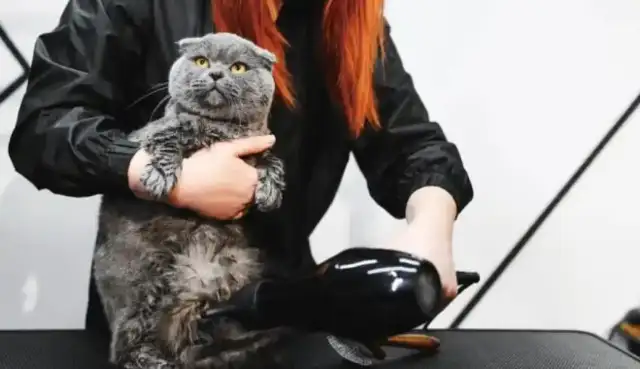
Its economy, driven by love and company, is moving at an alarming pace from household to market, from single consumption to full-industry chain development. According to the 2025 White Paper on the Chinese pet industry, by 2024 the total number of Chinese urban dogs and cats had exceeded 120 million and the size of the consumer market had exceeded 300 billion yuan.
The large size of the market shows that pets have increasingly shifted from the role of “caregiver” to “family members”. New People's Weekly recently interviewed professionals such as canine conduct trainers and pet detectives. Their stories show that more and more people are taking care of their pets and that the consumption behaviour associated with them is new and diverse.
The pet economy is no longer simply “saturated” but extends to the full life cycle of pet foods, supplies, medical care, beauty foster care, behavioural training, professional competitions and even funeral insurance.
A pet training instructor, not a "headache doctor."
As the number of pets in cities grows, the co-existence of pets with humans becomes more and the behaviour of some pets is a source of greater concern for humanity. Training in pet behaviour has become one of the rapidly growing types of services in the pet economic market.
According to an interview with New People ' s Journal, the national certified canine conduct trainer Tang Zhuang said that pet training is a broad concept project that can be broken down down into skills training, behavioural training, etc. Common circus performances or work dogs involved in search and rescue are skills training. Training related to daily behaviour norms is classified as behavioural training.
“Skill training, in addition to common search and rescue, includes courier logistics companies that require help from dogs to conduct `security checks', as these dogs are trained to quickly identify the presence of prohibited items in cargo. Behavior training is aimed primarily at partners' pets in everyday life, and humans want "kids" not to shout, not to "dismantling home" when they are alone, to defecate, to be used to riding in cars, to be friendly to strangers and things, not to display aggressiveness, etc. These are behavioral norms.
According to Tang Yuen, the main targets of the current training on the behaviour of pets are dogs and cats. Of these, there is a greater need for dog training because dogs are social animals and are more exposed to unfamiliar environments.
In more than 20 years of practice, Tang has reached thousands of dogs and witnessed the gradual movement of pet behaviour training from cold doors to the general public and the growing size of the industry. In his view, on the one hand, as the pet market matured and public civilization developed, there was a growing demand for “behavioural norms” among young pet owners; on the other hand, rapid urbanization, with the simultaneous growth of humans and pets in cities, more crowded spaces and human-pattern contradictions, with corresponding increases in human demand for pet behaviour adjustment and establishment.
With regard to the price of training in pet behaviour, Tang Qi believes that the domestic market is at a “free pricing” stage. Based on his experience abroad, the price usually falls into two categories: “A sub-fee, possibly 50 euros at a time, and canine trainers help adjust it for 10 minutes; or an hour on time, $200 per hour, more expensive for dog training, possibly $600 per hour. At the domestic level, training cycles tend to be longer. Depending on the length of time, it may cost between $6,000 and $10,000.”
In March this year, Mr. Zhou, a citizen of Shanghai, approached a dog training facility for his family's dog, Wang Zai. Two years after Mr. Zhou had raised the “bong money”, the dog had brought joy to life, but it also suffered from headaches. It not only protects food, it bites suddenly when Mr. Chow and his mother are fed, it goes out for a walk and loves clashes with other dogs. Mr. Zhou hoped that the canine agency would help itself.
At the time, Mr. Zhou saw online that the head of the canine facility, a web-based red dog teacher with millions of fans, looked at the “success stories” published by each other, and that Mr. Zhou had taken the dog to the ground with determination and hoped that it would “change its face”.
The contract between the two parties provided for the training of the canine trainer in five basic instructions and six behavioural habits within two months, as well as for the correction of his behaviour in such matters as poking, biting and bursting, at a cost of $15,800.
The ideal is full, but the reality is so strong. When the contract came to an end, Mr. Zhou found that the training of the `Big Rich' was far from being as effective as expected, and the dog trainer took the initiative to extend the training. But when the dog trainer says that the dog is trained and the dog is returned, not only will the money still bite, but even simple instructions such as "delay" cannot be done.
In the General Classification of Occupations of the People's Republic of China (2022nd revised edition), published by the Ministry of Human Welfare, “Pet Training Mentors” are listed in separate rows. In addition, the Ministry of Human Welfare promulgated the National Standards of Vocational Skills for Petty Training Mentors in 2023. Now that the industry is moving towards regulation, why is it that some canine trainers are not as amazing as they imagined?
In Tang’s view, the services provided by some canine agencies in the country are not reasonable and require vigilance, as the different behaviour of pets is often linked rather than isolated. A problem of behaviour may be linked to multiple logics, not as simple as “the pain and suffering”. “The canine trainer is a very experienced profession. The behaviour of dogs can be better understood only when many different types of dogs are reached. Behavior training, which has lasted less than five years, or particularly young trainers, lacks relevant practical experience and cannot be trusted.”
Patrons, from childhood to "inner volume."
As the city grows more pets, more pet owners have to face a potential problem: How do we get them back if they're missing by accident?
Data show that on average one third of pets are lost during their life cycle, with less than 2 per cent of cats and 15 per cent - 20 per cent of dogs eventually returned to their owners. The loss of the pets led to the creation of a new industry — a pet-hunter, or “petty detective”.
In February 2021, a blogger explained on Twitter the special experiences of himself and his roommate: his own cat opened the door and disappeared after sneaking out of the house. They found a pet detective, and they recovered the cat by analyzing traces of footprints, cat hair, etc. The microblogging was quickly transmitted over 30,000 times, and the profession of “Pet Detectives” was more known.
The detective who is grateful for this tweet is Zhang Shai Fei, 29 years old. Since he began his career in 2020, he has helped to find more than 1,800 lost pets, of which more than 1,600 are pet cats, in five years.
In an interview with New People's Journal, Zhang had just finished an all-night hour, directing customers online to find cats. There are now seven members of his team, six boys and one girl, all “after 95” and “after 00”.
By helping masters find thousands of cats, the knowledge of cats is growing. Cats are lost, mostly curious, wanting to go out. Sometimes they jump off buildings, which is also the most painful thing for Zhang, because some traditional imaginations think cats are coordinated and do not fall, and in fact cats fall from above the third floor, break bones and even risk falling.
Usually after receiving a single demand, Zhang will give the cat owner a description of the cat's condition, such as name, variety, courage and habits, as well as a few floors and surroundings. Since cat walking leaves footprints and hairs, the most important is recognition of footprints, cat hairs and faeces. Some of the shit leaves cat hair and can be pulled out. Each time he was on duty, he and his colleagues carried equipment such as flashlights, catnets, cat cages. Upon arrival in a lost environment, an excursion usually takes a flashlight and looks at every floor, every corner of the building, and there is little dust and traces on the ground.
Looking for a pet is a manual job. Owing to uncertainty about the timing of cat and dog displacements, it is sometimes day and late at night. Whether it's rain or sun inflammation, cats and dogs are lost. Although Zhang Flying and Teams are based in Shanghai, their clients have come from all over the country over the years, mostly to search the relevant information online after their pets have been lost and find them. He told the press that the most distant search for a cat was the flight from Shanghai to Inner Mongolia, and that the owner of the cat had taken the cat out on a trip, and the cat had left on his way. Over the years, Zhang has also become accustomed to this working pattern.
Six years ago, Zhang flew to Shanghai to look for work and was exposed to pet hunting. Owing to his high strength, physical strength and vision, he successfully joined the then team once interviewed. A year later, Zhang Xiaoxing created his own studio. He recalled that there were no more full-time workshops throughout the country, and that he was the first one. In the five years he's been looking for favors, more people are willing to pay for pets. It may have been mid-aged, they have some economic power, they spend money looking for cats and dogs, but now they pay more young people.
The price is not cheap, depending on the length of the work, between $2,000 and $8,000, and there are a number of out-of-the-field orders involving fare hotels, which ultimately cost tens of thousands. At the outset, Zhang Shao Fei also met a client who had offered to pay in advance, but in fact found the pet and managed to “run away”.
Starting in 2023, the pet industry also began to become an "inner volume": "We received almost 100 pets a month in previous years, and now we're down to dozens a month. Because the industry has expanded from a few of the original hobbies to two or three hundred. I understand that now almost every second-line city has a pet team.”
There are more pet teams, but Zhang Fei thinks the industry is mixed. “The owner of the cat told me that his cat had been missing for more than 20 days, and that the studio and he were `promising' to find it and let him pay first. And then, of course, he didn't find it. He was in his studio. The master came to us after being deceived."
Interestingly, Zhang has discovered that more and more people have recently used DeepSeek to find pets. DeepSeek is consulted for the first time when a pet is lost and no idea is forthcoming, and the other side offers some general possibilities. Some of the pet owners told Zhang Shao Fei that in some cases the guidance had already solved the problem.
“Pet Lawyer” to resolve new economic disputes
Just in August 2025, a “debted cat” was brought to the attention of the entire world in the auction message published online for the Ali asset auction. The specific information indicated that the auctioned beaver had a starting price of $500 and would be shot at 10 a.m. on 3 September 2025. The former owner of the cat, who unfortunately became a debt-free asset, was placed in foster care in a pet shop.
This latest case reveals a new phenomenon: when more and more humans view pets as “family” or “property”, new economic disputes have arisen.
At the beginning of 2025, CHOI Chan became a “paternity lawyer” and began to deal with special cases: couples divorced and to whom are the pets? What's wrong with a cat? The owner is dead. Can the pet inherit? These cases often involve small amounts of money and emotional attempts to use the law to give themselves a solution.
In 2024, the Second Intermediate People ' s Court of Shanghai issued the Model Agreement on the Integration of Patients after Divorce, which is used to resolve the issue of whether a pet or a man are women after divorce. It is specified in the protocol template: “As a result of the divorce, the dog is shared by the man x per cent, the woman x per cent, normally in the custody of the man/woman, and the man/woman pays the cost of the custody of the property x x x dollars per month. The dog may be used once a week by the man/woman, taken from the man/woman's residence at xx per morning and returned at xx per afternoon.” At the same time, it is clear that, during the period of use or management, if the dog is damaged or lost, the user or manager bears liability, including moral damages. In the present case, in the face of the custody of pets, “a model of a pet-attribution agreement” is regarded by legal persons as an alternative solution.
In a recent interview with the media, CHOI Chan indicated that most of the cases currently in hand were related to pet medicine. Many of the pet owners found a lawyer and only asked for a statement that they could help. Although the doctor at the pet hospital said it was a “small problem”, the pet died for no reason.
Outside, it's not new to sue for pets. The name of the pet lawyer has been in the United States for many years, with an annual salary of approximately $90,000. In recent years, pet lawyers like CHOI Chan have become more numerous in the country. Six months ago, Choi and his colleagues set up a community of pet lawyers, which soon surpassed 1,000 members.
The existence of pet lawyers stems from the increasing complexity of pet-related legal issues. In addition to the economic and medical disputes mentioned above, abuse and abandonment make more people want to speak out for pets. In 2025, representatives of the National People ' s Congress and the Vice-President of the College of Agricultural Sciences of Anhui Province, Zhao Zhou Ping, presented a bill for a partnership animal protection and management law. According to Zhao Zhou Zhou Ping, the current legislation in force in the country is “scattered” in relation to the management of partner animals, resulting in the persistence of ill-treatment, abandonment and illegal trade. He recommended the adoption of legislation to clarify the responsibilities of breeders, regulate reproductive transactions, establish a system of rescue for stray animals and include abuse in the scope of the law to protect the rights and interests of partner animals with the force of law.
In CHOI's view, ill-treatment and abandonment are so common because of the “low cost of violating the law”, but he remains optimistic that there is a need for another “national first” case law to emerge and then promote the development of industry regulations, local regulations and judicial interpretations.